



Lecture by Associate Professor Alessio Cascardi “Next-Generation Inorganic-Based Composite Systems for the Retrofitting of Buildings: Assessment and Design”
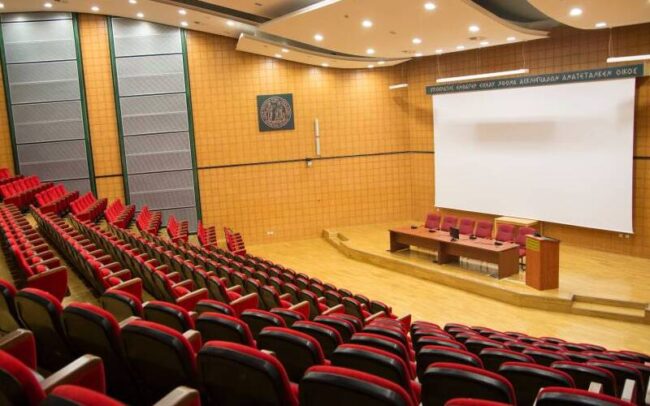
The lecture titled “Next-Generation Inorganic-Based Composite Systems for the Retrofitting of Buildings: Assessment and Design” was delivered by Professor at the University of Calabria, Italy Alessio Cascardi on Thursday, May 21, 2026, at 09:30 in Room A4 of the Civil Engineering Department.
The event was broadcast live via MS Teams, on the department’s YouTube channel, and through the DIAVLOS service.
ABSTRACT
A significant portion of the existing masonry building stock worldwide fails to meet current seismic safety requirements and thermal comfort standards, prompting growing interest in retrofitting solutions capable of addressing both structural and energy deficiencies. In this context, innovative Inorganic Matrix Composite (IMC) systems – particularly those based on thermal resistant geopolymer mortars – offer a promising alternative to traditional lime based composites, combining enhanced mechanical performance with reduced thermal conductivity. This study presents an experimental investigation on small scale masonry panels retrofitted with double-sided IMC layers, assessing both in plane shear capacity and thermal resistance. The results demonstrate that geopolymer based IMCs significantly improve the mechanical and thermal behavior of masonry walls compared with conventional solutions.
Complementing the experimental evidence, the study also addresses a major gap in current design practice: the lack of reliable predictive models for the in plane strengthening contribution of IMC systems, including both Fabric Reinforced Cementitious Matrix (FRCM), Steel Reinforced Grout (SRG) and Composite Reinforced Mortar (CRM) configurations. Existing formulae often neglect the specific role of the matrix and the matrix to fabric bond interaction, leading to inaccurate strength predictions. To overcome these limitations, a unified empirical set of equations is proposed, derived from an extensive dataset subjected to clustering, cleaning, and statistical processing. The model incorporates both quantitative parameters (geometric and mechanical properties of masonry, matrix, and reinforcement) and categorical variables (IMC type, use of connectors, and strengthening symmetry). A bond exploitation ratio is introduced and validated for both FRCM and CRM systems. Comparison between theoretical predictions and experimental results, supported by parametric analyses, confirms the reliability and improved accuracy of the proposed formulations.

Read also

Lecture by Professor Adriano Alessandrini “Advanced sharing and on-demand transport services dimensioning and managing them”
The lecture titled “Advanced sharing and on-demand transport services dimensioning and managing them” was delivered by Professor at DICeA – Dipartimento di Ingegneria Civile e…
More